Showing posts with label video. Show all posts

Wednesday, July 20, 2016

Microcollections 1: Superhero Ephemera

As I consider my collections, the ways I go about organizing them, adding to them, and appreciating them, I also realize that the large collections (primarily my comics, Bionicle, and Lovecraft) are accompanied by smaller collections, some intentional and some completely arbitrary. I thought it would be fun to have a few brief looks at some of the smaller collections in my collection of collections.

(*sigh*)

First up, superhero stuff.


 While clearing up our storage room the other day, I opened up a box I had labeled "Superhero Ephemera." Inside were these little treasures. I used to have some of them in the spaces between my comic boxes, but having rearranged those shelves to optimize space, the ephemera was relegated to a box. However, a few weeks back we visited the very strange and awesome Miracle of America Museum in Montana, a place where knick knacks and stuff were just spread over a warehouse-sized space to celebrate the innovation of the American nation. I have a few more thoughts about that, but I'll save it for another post. Inspired by this, I made a little bit of space to display some of my knick knacks, superhero style. The accumulation of this little collection is a random process. Many of the little figures, mostly fast-food toys, are things that came in bags of Bionicle that I get from thrift shops. There's toys that come from Kinder Egg-style candies, inserts from Wizard magazine, lantern rings that were given away during the "Blackest Night" event. The black Spider-Man toy in the bottom left corner has been the subject of one of my Horror from the Dollar Bin posts, a naughty little toy if ever I've seen one. There's a couple in there, the Wolverine at the front and the similar Captain America at the back, that are actually pens. And then there's the Fleischer Superman cartoons, on video cassette. There's a belt buckle, little tiny reproductions of comics, bracelets, zipper pulls, little figurines. The day after I took this picture, I got a Super Grover figure in a bag of Bionicle parts. He graces the shelf now too.

A fairly important part of my dissertation is going to be looking at exactly this sort of intrusion into the material realm of these kinds of fictional characters. Toys and knick knacks like these make up a sort of mythic background radiation. We see them at flea markets, garage sales, McDonald's, and pay them little attention. But they are important manifestations of fiction into reality, and I think that's something that's worth thinking about.

Wednesday, May 4, 2016

The Building Chronicle: A Critical Consideration of LEGO's "Bionicle" Series - Building Through part 3.1 - 2003


2003 was an exciting year for Bionicle. Following the release of the first wave with the Bohrok-Kal, news broke of a film in the works. I was absolutely stoked to see a Bionicle film, to see the Toa, even if it was the Toa Nuva, walking around, talking, interacting with an environment as rich and mysterious as Mata Nui.


It was…well, anti-climactic. But I think that a problem that often happens with childrens’ features that are released directly to home media is that they’re not courting the adult market that a film released in the movie theatres needs to. Even if that market is just parents taking their kids to the film, there has to be something, so the parents will deign to come back for the next film. Pixar are masters of this. Bionicle: The Mask of Light was not.

But that’s not that big a deal. Not all branches that a franchise grows into can be amazing.
How were the toys?
 
I sometimes get the feeling in fandom that 2003 isn’t well-liked. The proto-titan sets of Jaller and Gukko, and Hewkii and Pewku usually meet lukewarm reception, as do the revamped Tohun….er…..Matoran (their name is changed as Lego is faced with a lawsuit from the Maori people over intellectual property issues – my thoughts on this are stewing still – I see both sides, and I’m not sure what the solution is). The Rahkshi are cool, but are clones, as are the earlier Bohrok-Kal. But there’s some interesting spots. In lieu of a video of me putting something together, I’ll jump right in, and we’ll look at the smallest sets of the wave, the Matoran.

Part of the story of Mask of Light is the gathering in Ta-Wahi of teams from various villages for a Kolhii tournament. Each Matoran set from this wave came with a Kolhii stick and puck, and a gear mechanism that allowed a swinging motion of the torso. They were sort of like Bionicle Hockey players, but a little less sturdy than one might hope. The looseness of the gear system also makes them quite difficult to pose, often relying on the stick to steady a wobbly body.
To cap this sort of disappointing revamp of what were once badass villagers, there was no combiner and only three of the villages were represented – Ko-Wahi, Ga-Wahi, and Po-Wahi, or White, Blue, and Brown. The larger sets featured red characters from Ta-Wahi, but never were any Onu- or Le-Matoran produced. And as a result of the colour schemes of the existing ones, MOCs are difficult to make. 
But back to the combiners, or lack thereof. 
A few years back, I discovered something in the recesses of BioSector01 (and, actually, right now, as I search for the link, I’ve just discovered something else in there, another Kabaya combiner – off to hunt again!). This picture, of what’s called the Matoran Kohlii Combiner is all the information I have about this model. I don’t know where the picture came from. But, as I gradually gathered the pieces together, I decided to attempt to build it. It’s an interesting process in the case where all one has is a relatively low-res picture. What I did was first figure out which Matoran it utilized. Then I went through my collection and put together as much of each of them as I could, which was a fair bit. And then, using only those pieces, I tried to put this four-armed dude and his dog together. The result was pretty good (though I’m still missing two light blue torso pieces for the feet.


I’ve messed about trying to make Matoran for the other villages, but their body pieces are so specific to their region that it’s virtually useless. I painted up some pieces to make an Onu-Matoran once, and I may attempt with my newfound proclivity for painting to create some Le-Matoran. We’ll see.

Before I finish for today, I can’t remember if I’ve mentioned the BioMedia Project before, but it’s an online initiative to archive all of the Bionicle digital media from the first and second generations of the series. Bionicle was one of the first media properties to really explore digital space, and it’s worth noting how it all happened. Here’s a video from 2003, one that was unlockable with codes one collected from the cannisters, called “Rahkshi Rock.” We’ll talk Bohrok-Kal next time.


Wednesday, February 3, 2016

The Building Chronicle: A Critical Consideration of LEGO's "Bionicle" Series - Building Through part 2.3 - 2002


Welcome to The Swarm! Above you see the majority of my Bohrok swarm, minus of course the 2003 Bohrok-Kal, and the Bahrag Spider, a combiner that wouldn't fit on the shelf, and that I'll show a little further down.

As I noted in my introduction to 2002, the cloning of the Bohrok in this wave led to a troubling trend in Bionicle. The two villain series of the next wave, the Bohrok-Kal and the Rahkshi, follow this trend, changing only colour and accessory, but keeping fundamental builds the same across the series. It's for this reason that I find myself gravitating, during this particular build-through, to the combiner models. They simply offer more interesting entertainment, and sometimes challenge, than the official, or mainstream, models, however we might want to refer to them. Having said this, I do like the Bohrok and the Bohrok Va. Unlike the Toa Nuva that they oppose, these models offer far more flexibility when it comes to posing, though not quite as much as the waves later in the decade. The Bohrok attack function is also pretty neat, and offers a nice combination of action figure and Technic parts. If only they'd been a bit more varied in their construction. The smaller Bohrok Va are also mostly cloned figures, though some of the leg and head assemblies vary enough to keep them interesting, despite their low piece count. Again, it's the combiners (or those that I have, at least) of these little figures that I find to be the more interesting parts of this wave.

But before I wax lyrical about the combiners, there's also the Bahrag Twins, Queens of the Swarm, to consider. Basically, they're Technic dragons. These figures, and the larger figures from the next wave, are ancestors of the Rahi from the first wave, built almost entirely of Technic parts, and not clad in any armour or accessories to disguise the fact. Whenever I build the Bahrag I have the same problem: once I've finished one, I'm less-inclined to build the next, since they are virtually the same model, part colour aside. They're also fairly lengthy builds, so once one is done, I usually take a break and build some of the other Swarm members before moving on to the next Queen.

These next two models are the combiners, the Bohrok Kaita, the instructions for which are in the backs of the Bohrok books. Though there are slight variations in the torso builds, these models are very similar to the Toa Kaita and Toa Kaita Nuva. This is not to say that they're uninteresting, and one of the most fascinating things about the various combiner models is the ability of the Lego designers to create a relative coherent model out of pieces that were never actually designed to create such things. The pieces in these models were explicitly designed to build the individual Bohrok models. Combining them into these giants is really pretty cool. Both retain the Bohrok head -thrusting action, and are relatively poseable, though the legs are a bit wobbly, due to the nature of the individual Bohrok leg pieces.


 The next combiner is a Japanese model, the construction video for which I posted in the introduction to this section. Like it's larger compatriots, it's a bit wobbly, but the fashioning of accessories out of the Bohrok body parts, and the aesthetic quality of the model make it something interesting. The instructions, much like those for the Kabaya Rahkshi combiners from the next wave, are worth mentioning as well. Unlike the step by step instructions commonly found in Lego manuals, these combiner instructions assume a familiarity with how the pieces work, and instead of going piece by piece, the instructions go section by section. It raises the level of the challenge, especially when one is working from low resolution scans.


These next two models are Bohrok Va combiners. Of the combination models that are officially recognized, those for the Bohrok Va are the ones I have the least of. There are two more variations of the model on the left, another Kaita style model using blue, white, and green pieces, as well as a number of small animals that could be constructed by combining the pieces of two models. They are also some of the most difficult and rare pieces to find, especially the feet, which were produced and included in these particular colours only in these sets. But if there was nothing left to hunt for, I'd probably have lost interest a long time ago.


The final combiner for this time is the Bahrag Spider. According to the BS01 wiki, this creature has no canonical significance, but that doesn't keep me from including it in the Swarm. Perhaps the Bahrag Queens were actually triplets, not twins, and the Spider is the forgotten and deformed third sibling. Actually, that's my headcanon now. It's a fun build, for sure, and does some interesting things with the Bahrag pieces. Beneath the picture, I've included a video demonstrating its biting mechanism.


That's it for today. Next time we'll finish up 2002 with the menagerie of combiner fauna and Master Builder Set, all presided over by the two version of the Exo-Toa. See you then.

Wednesday, January 6, 2016

The Building Chronicle: A Critical Consideration of LEGO's "Bionicle" Series - Building Through part 2.1 - 2002

Welcome to 2002. Today will be a brief introduction, and then we'll have a look at the Bohrok, the Toa Nuva, the early "titan" sets, and the menagerie that is the Bionicle Master Builder Set. We're still very early in the series, but the 2002 line brought to Bionicle one of the more reviled aspects of the series: the clone.

Though the original Toa and their Matoran/Turaga counterparts were very similarly designed, there were divergences, slight and not-so-slight, that distinguished figure from figure. Whether it was Gali's dual arm motion as compared to the Tahu and Kopaka single arm, or Onua's head and neck placement, or the vast difference of Pohatu's upside-down torso, the figures were based around a similar morphology, but not identical.

This comes to an end with 2002 first wave of Bohrok, the insect creatures that swarm the island once the Toa have completed the first phase of their quest and retrieved the golden masks.


Though this picture does contain some variety of design, if we look solely to the Bohrok, it's merely a matter of colour that differentiates them. Okay, not only colour. They do each come with individualized krana (the small rubber mask-like bits that fit inside their carapaces) and individualized hands/weapons. These, however, are more accessory than integral body feature. The body build is identical, with no flourishes depending on environment or personality. It suits an insectoid/robot hybrid, I suppose, but makes for a sort of boring wave of figures. You'll note some variations on that shelf, which I'll post a better picture of next time, but these are combiners and non-canonical models, rather than the main figures of the wave.

And, on the topic of combiners, if you missed the previous post in the series, it highlights what I think is the best build of the wave, Wairhua Nuva, the combiner model of the Nuva versions of Gali, Kopaka, and Lewa.

We're also introduced to more powerful Toa in this wave, with the advent of the Toa Nuva, and I'll admit straight out that though I'm a fan of this early attempt at armouring the figures, I don't like the mask redesigns. The original masks were inspired, I think. These protodermis-mutated masks are too big, and a bit cartoon-y looking for my tastes. Again, though, we'll look at this more fully when I deal with the Toa and Matoran of this wave.

2002 also introduced one of the more interesting sets of the series, the Lego Shop exclusive Master Builder Set, which offers 15 different models of Mata Nui fauna. I really love this set, and to illustrate each of the animals, I've gone through my collection and built each one. Though they're not the same colours as the Master Builder Set originals, it will give a sense of the creatures presented in this relatively rare set.

I don't have too much in the way of ancillary merchandise for the 2002 wave, though there certainly was a fair bit made. I'm not sure if it'll warrant its own post, but I'll have a look somewhere at the 3 or 4 pieces I do have that aren't building sets.

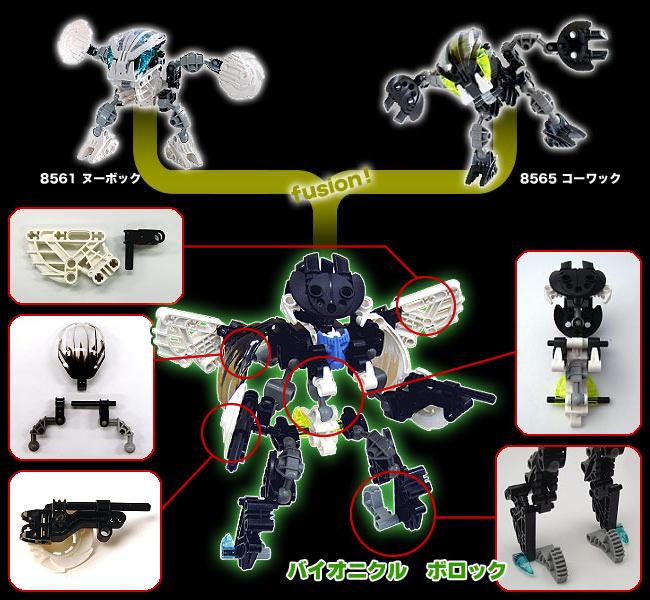
But before I go for this week, another building video. This is a 2002 Japanese Kabaya fusion of Kohrok and Nuhvok, the white and black Bohrok, and it really begins to show the difference of aesthetic in combiners that I looked at here. So enjoy the video, and next time we'll look closely at The Swarm!


Tuesday, October 13, 2015

The Building Chronicle: A Critical Consideration of LEGO's "Bionicle" Series - Building Through part 1.1 - 2001

Thanks to the wonderful individuals over at the Facebook Bionicle Community Group, I've been inspired to take up pen (or keyboard) again on this blog and begin to really look at Bionicle. I'm also beginning to think about the series' place in my dissertation, so here I will throw out thoughts and ideas that I'm having about the series, through all its media, some of which may stick, some of which may not.


To start, then, I'm going to be building through each of the years of the Generation 1 series until it's demise in 2010. The series undergoes remarkable shifts in aesthetic and genre over the course of it's 10 year run, so there'll be plenty to talk about and think about.

In the interest of these posts not being overly long, I'll be splitting my considerations of each year into manageable parts, hence this being part "1.1."

This build through of 2001 includes both commercially available models and the officially-sanctioned/canonical combiner models published by Lego. The first thing to note is that officially-sanctioned and canonical are not necessarily the same thing. We have officially-sanctioned combiners for the Turaga, published both by Lego and by Kabaya in Japan, but the models depict characters that make no appearances in the storyline. For officially-sanctioned models, I accept models published either at the Lego website, in the Lego magazine, or by third-party distributors of Lego. The most prominent of these last is Kabaya, and I'll be sure to point out these Japanese takes on the Bionicle universe when they appear. As I noted here, the aesthetic of the Japanese models is quite different from the European and North American aesthetics, so the models are worth considering closely. Later into the build, once we reach 2006, we'll also look at a pair of Korean Piraka models, assuming I've found the pieces for them by that time! A final type of model I consider, and collect, is the contest-winner models that occurred through the line's history. These models are made canonical by their inclusion in the fictions that accompany Bionicle, and their creators have been kind enough to post instructions at various locations online.

Since this is going to be, at least partially, preparation for my dissertation, I'll also be looking at a few books as I'm building the series, and probably drawing on them for theoretical formulations. Daniel Lipkowitz's The Lego Book is a decent, and colourful, history of the company and the toy. Jonathan Bender's Lego: A Love Story is a nice piece of reflection and reportage on the phenomenon of AFOLs (Adult Fans of Lego), and Mark Wolf's Lego Studies is a collection of scholarly essays about the phenomenon that is Lego. They're very different perspectives on the same toy/media, which will be fruitful in my consideration of Bionicle as a nascent fictional mythic structure.


To begin with, here's the whole of my 2001 collection, with the exception of the comics. I'll post a picture of them when I get to the inevitable extended meditation on Bionicle in sequential art.


I'll zoom into each section as we're going along, comment on the builds, the place of each character or creature in the story, and on the ancillary merchandise surrounding the series. There is one MOC in that picture. I've always been a fan of the infected Tohunga (more on that term later) version of Makuta from the original animations on the Lego site. I painted one up with the rust-looking stuff and he's sitting in the center of that picture, stroking the back of a Fikou spider. He's probably the only one of my own MOCs I'll be including here. Other peoples' MOCs, contest-winners in particular, will make appearances by virtue of them having been placed in continuity.

To finish things off with this initial post, here's a quick video of my constructing Kirikori Nui, the first official combiner of the Bionicle line, and the last model I put together yesterday in my build of 2001. I'll look more closely at this model and the Ranama, as they are combiners that utilize pieces from non-Bionicle sets, and are thus unique in the line. But we'll save that for another day.


I'm hoping to update this blog at least twice a week, perhaps Tuesdays and Thursdays, as those are the days I'm not on campus for work. I'll do my best, and even if I'm going to miss a day, I'll update to let you know that. Thanks for following along, and happy building.