Showing posts with label links. Show all posts

Sunday, February 19, 2017

The Building Chronicle: A Critical Consideration of LEGO's "Bionicle" Series - Building Through On Hiatus


No that the series has been particularly punctual anyway, but I'm going to take a break from the Bionicle building for a bit. My thoughts and interests are going in other directions at the moment, so rather than force myself to build through, I'd rather wait until I'm back in the mood to have interesting things to say. Probably should have done this a while ago. I will continue the series, eventually.

Thanks for reading along thus far, and have a look at some of the other collections I write about.

Thursday, December 22, 2016

The Building Chronicle: A Critical Consideration of LEGO's "Bionicle" Series - Building Through part 5.1 - 2005


Welcome Back!

It's time to get this show on the road again, and not solely because I'm tired of having the 2005 models on my shelves.

(Though I am dying to build some of the 2006 stuff)

We'll start off today looking at the Visorak. Though they're called spiders, these creatures don't really conform to our definition of arachnids. Even counting their pincers, they've only got 6 legs. However, we're not talking about creatures from our reality, but from that of Bionicle, so spiders they are.

The Visorak represent a nice change for the villains of the series in the six sets offered. Though ostensibly clones, there are subtle variances in the builds and in the pieces used that give each one a bit more character than their Vahki predecessors. Also, these sets reintroduce the original brighter colours of the first three years into the series, which brightens up what had become a very dark series of toys. Of course, the darkness of the colour scheme matches nicely the darkness of the story at this point - the Metru Nui series is a grim one.

What 2005 really provides for us is a remarkable amount of combiner models. Not only are there combiners included in the instruction booklets, but canonical models were also made available in the Lego magazine and on the website. While some of the combiners suffer a bit from that problem of the earlier ones, in that they look like they've been cobbled together from other sets, some actually look like they could have been marketed, official sets. Let's have a look at some of the Visorak combiners.


The Kahgarak is an elite Visorak, built from the blue and white sets commercially released. It plays a part in the novel series, and of all of the Visorak sets (with the exception of the Zivon), it's the only one that actually had eight legs, and can therefore be considered a spider in both Bionicle lore and our own natural science. The Gate Guardian, on the other hand, goes quite a different route, and though it incorporated elements from the Visorak sets, its look is decidedly un-spiderlike. If I'm to be honest, when I build this set, it reminds me of something from the Beatles' Yellow Submarine film. A little awkward, slightly ridiculous-looking, but ferocious with those pincers nonetheless.


The Chute Lurker and the Venom Flyer, though they share a number of characteristics with the Visorak, are actually considered separate species in the Bionicle lore. Both are affiliated with the Visorak, and are used for particular purposes by the horde, but are not Visorak proper. As these creatures were all created by members of the Brotherhood of Makuta, we could perhaps consider the similarities to be aesthetic choices made by a particular member. The creation of the Visorak is credited to Makuta Chirox (who we'll meet in 2008), so perhaps these other creatures were also created by him. I quite like the idea of an aesthetic that distinguishes particular branches of the Rahi, rather than an evolutionary path.


The last of the smaller Visorak combiners is the Parakrekks. Unlike the previous combiners, this one represents a creature that menaced a Toa team many years in the past, and though there are supposedly still surviving members of the species, it seems they have very little really to do with the Visorak and their concomitant creatures. As such, it's the combiner that bears the least resemblance to its constituent parts, and looks more like one of the titan sets, really.


Last, but certainly not least, we have the Zivon, a combiner of all six Visorak sets. It's a bit wobbly, hence my inclusion of a stand beneath the model. In-story, this is a creature that terrorizes the Visorak, and lives in a shadow-filled realm from which it is only seldom summoned. As with a couple of the aforementioned combiners, this set is not to scale with the Toa Hordika, Visorak, or titan sets from the same year, but is instead a smaller version of a monstrous creature. Perhaps one day I'll attempt a properly-scaled model of the Zivon, if I can determine what that scale might be.

Next time, we'll have a look at the Hordika and the Rahaga, the heroes of this particular part of the series. Though one of the Hordika acts in a less-than-heroic fashion, and the Rahaga are far more than they seem.

Wednesday, August 17, 2016

The Building Chronicle: A Critical Consideration of LEGO's "Bionicle" Series - Building Through part 4.2 - 2004

Okay, catch up time again. I feel a bit bad rushing through 2004, but I really want to get on with thinking through this series, and the 2004 line have been built and on my shelf for a long while now. Plus, 2005 has some really very cool combiners I'm eager to get to. Once again, I'll apologize for the cellphone picture quality, though this is a panorama, so that's kind of neat, right?


One of the earliest posts in this series was of Ultimate Dume, the large figure next to the lava lamp in this picture. He's one of my favourite builds in the series and provides a remarkable amount of poseability and articulation. He incorporates the three Titan sets from this wave, the first true titan sets, with the possible exception of 2003's Makuta. It was recently pointed out in fan circles that Makuta, considering his fundamental role in the series, only really receives proper sets in these early years. Ultimate Dume is his manifestation at the end of the first Metru Nui storyline.


A closer look, and we can see the Vahki, a robotic police force that kept the Matoran of Metru Nui working. It's a bit strange to me, this need for enforcement drones, but when one realizes that the Matoran exist within a vast robotic body (more on this in later years), perhaps the Vahki can be seen more as control programs, making sure that the smaller parts of the body accomplish their assigned tasks. To the far right of the picture is Turaga Dume and Nivawk, one of the titan sets that comprise Ultimate Dume. This version is meant to be yet another manifestation of Makuta, who took over Dume's form in the last years of Metru Nui. This ephemeral nature of Makuta is perhaps a clue as to why we don't see any other actual physical manifestations, though he does end up possessing numerous characters throughout the rest of the series. As Bionicle exists in a far simpler world, similar to that of superheroes, Makuta's actual possession of other entities, and his evil nature, make him easy to read as a metaphor for the evil that seems to be inseparable from sentient creatures.

Also of note in this picture are the Kranua and the Kraawa, combiner models using, respectively, the Vahki and the Toa Metru. As the parts comprising each figure type become less and less specialized over the course of the series 10-year run, the combiners we're given are more like sets themselves, rather than models cobbled together from other sets - the 2004 combiners suffer from this. 2005's combiners take a quantum leap forward in dealing with this, but the 2004 combiners definitely point toward a more nuanced idea about combiners from the Lego designers responsible for them.


The final bit of this year shows us the titan sets Nidhiki and Krekka, the combiner models Kralhi and Kraahu, and one of the first really complex models the instructions for which appeared in Lego Magazine, the Lohrak. The combiners are yet more robotic policing drones, and there's something really horrendously totalitarian about the idea of these massive robots keeping watch over the Matoran, who fill the roll in the series of the innocents that we're meant to sympathize with. Krekka and Nidhiki are servants of the possessed Turaga Dume during this story, Krekka being one of the most reviled sets because his build is so chaotic. I'd agree with that assessment, but I also recognize that it comes from a place of morphological symmetry which we human beings struggle with. Nidhiki is one of the most interesting characters in this series, and does much to add to the lore of Bionicle, as it is revealed that he was once a Toa who defected to a league of assassins known as The Dark Hunters (who we'll see a little bit next time), and was mutated into his current insectoid form.

And we'll finish 2004 there. A good year, full of innovations in both builds and story, and a real darkening of the plot, which only continues in the next story with the animalistic Hordika, and the almost-betrayal by one of the Toa Metru of his team.

Wednesday, August 3, 2016

The Building Chronicle: A Critical Consideration of LEGO's "Bionicle" Series - Building Through part 4.1 - 2004

Since I've dropped the ball a bit on this series, I'm going to play some quick catch up and do a two-parter on the beginning of the Metru Nui saga in 2004. As I write this, the Bionicle fan community is reeling from the news that Generation 2 is being cancelled. There's a lot of vitriol and criticism aimed toward Lego's handling of this new iteration of Bionicle, which I've come to understand is what fans do when they feel they've been wronged by a company or property. I get it, but I also think that the attitude that comes across of a company somehow owing something to the fans is a bit misguided. Yes, we buy and support their products, but these companies put the products out to make money, not to contribute somehow to culture, be it big or small. I'm happy to have had a bit more Bionicle, to have been given some new elements with which to build, and to have seen new interpretations of some of my favourite fictional characters.

One major criticism has been over the simplicity of the storyline, a criticism with which I fully agree. That said, at the end of the Netflix series Journey to One, we're introduced to a shadow realm within which Makuta is trapped, along with a number of Otokans, so I think that had the series continued, we would have seen some interesting cross-dimensional battle. And intimations of a coming Toa of Light were also pointing toward a more fleshed out storyline.

In Generation 1, 2004 is where the story really started to complexify. The revelation that the Turaga of Mata Nui had been Toa thousands upon thousands of years ago, in a city of great technological accomplishment to boot, began the movement of the series through its pseudo-fantasy beginnings and into a cool amalgam of fantasy and science fiction - an amalgam that I think I might equate, as I do with so much, with myth.


(Let me just apologize for the picture quality. I used my cell phone, and the lighting was a bit low.)

So what do we do with the fact that the Matoran and their protectors lived in an island city ten thousand years ago, a city located deep beneath the island of Mata Nui, and that they somehow were forced to migrate from that city to their far-less-technological island home? Coupled with that is the fact that not only were the village elders of Mata Nui Toa, but they were shepherded through their transition into Toa by an even older Toa, last surviving member of his own team. Four years into the story we begin to realize that there's so much more going on than simply a battle between Makuta and the Toa. These new/old Toa are far more unsure of themselves, and the shift of colour from the bright primary colours of the Toa Mata to the darker colours of the Toa Metru signals a shift in tone that resonates through the rest of the Generation 1 story. Even more interesting is that these Toa were originally Matoran, so we begin to question where exactly, or rather who exactly, the Toa Mata came from. The answer is not so simple. Further, these Toa are aware of the history of these heroes through a vast and proud history, and of the various factions around their world that oppose both the Toa and the Great Spirit, and who support the machinations of Makuta. Clearly by this point in the series' production, Lego had decided to let their creative team loose, and the team had jumped at the chance.

But what of the builds?

As I noted earlier, the Toa Metru are the first figures to allow for articulation of the head piece, giving us the ability to use that articulation to communicate emotion and attitude. It's a quantum leap forward for the toys. Not only this, but the arms now have elbow and knee joints, so action poses become a possibility - the toys are beginning their move from mechanical/Technic building to the portmanteau "craction" figures. We still have a gear system inside the Toa's bodies, which does make posing from the shoulders difficult, and it's a difficulty that was only ever solved by removing the gear systems altogether. Whether or not this was a good idea is something best left to individual opinion. The Matoran builds of this wave are only slightly better than those of the previous wave. They're not particularly wobbly like the 2003 Matoran, but they're also not particularly poseable, given the limited range of movement of their arms, legs, and heads. They are also only really nice to look at from the front. From behind, they are completely unfinished, which makes posing the characters in conversation with others a problem.

Off to the far right in that picture you see Toa Lhikan, last survivor of an older Toa team. His build is identical to the Toa Metru, and it's really his steed that is the interesting part of that set. The Kikanalo is a herd beast that roams the stone realm of Metru Nui, and represents one of the first non-Toa creatures to be given the same articulated treatment as the Toa themselves. This is the wave that introduces the Titan sets, which is where we'll pick things up next time.

Wednesday, July 6, 2016

The Building Chronicle: A Critical Consideration of LEGO's "Bionicle" Series - Building Through part 3.4 - 2003


As we come in for our finish of the 2003 sets, I'll apologize for the decline in quality of my pictures. 2004 will be better, I promise. One of the things the 2004 wave introduced to the series was the idea of the Titan figure - larger-scale figures that combined the action figure style builds of the Toa with more complex Technic pieces. The large sets from 2003 prefigure these Titans, but don't quite qualify.

The Mask of Light follows the exploits of two Matoran, Jaller and Takua. They are sent on a quest to find the Seventh Toa, the Toa of Light, which takes them through the varied landscapes of Mata Nui, and in and out of conflict with the Rahkshi. As with most children's movies not intended for theatrical release, Mask of Light is kind of a drab piece of storytelling, more an advertisement than a story, really. It stands in stark contrast with the series of books that comes out in its wake, those dealing with the tales of the Toa Metru, which are routinely dark and explore some interesting aspects of morality and duty. Two of the large sets of this year depict these two main characters. Takua and Pewku is a pretty neat set. The giant crab that Takua rides around the island is a neat mix of Technic elements, and its movement mechanism, small wheels concealed beneath moving, but cosmetic, legs is really great. As with the other Matoran from this wave, Takua (and Jaller) is a bit wobbly. The builds for the various Matoran throughout Generation 1 are amongst the weakest. The balance between simplicity and poseability never seems to have quite worked out, though I'd have to say that the Mahri Matoran from 2007 are probably, in my opinion, the best. The Jaller and Gukko Bird set is an odd choice, reflecting a scene from the film that lasts only moments, and the bird has no feet and/or stand on which to display it, hence, in the picture below, my choice to hang it from the bottom of the shelf.

In the picture at the top, it looks like we have three different versions of Makuta, which is sort of correct. The one in the middle is the Makuta set, and is actually quite fascinating for its identity as the only official model of the storyline's main villain that was ever released. We have combiners (such as next year's Ultimate Dume set) that portray versions of the villain, but never another specific set called "Makuta." This is odd, considering his intrinsic place in the tale. Makuta, the set, attempts to offer some more poseability, though combines it with the odd wobbly build of the Matoran from this year, making him a good model, but not a great one. The same goes for the two combiners that flank him. One is a beastial version of Makuta, a combination of the Makuta, Takua, and Jaller sets. Again, it's good, but not great. The other is Takutanuva, the end result of the battle between Makuta and the Toa of Light.

The last large set from this year is the Seventh Toa himself, Takanuva, who, you may be able to guess from the similarity of names, is actually MoL protagonist Takua reborn as a Toa. It's hard to see in the picture, but Takanuva comes with a really great vehicle that he can ride, though his actual build is still using Toa Nuva pieces from the previous year, and so is a little underwhelming. But the character himself stands as a messianic figure in the prophesies of the Matoran, so our interest in him can stem from the fact that this kind of a prophesied figure is not only brought into what really amounts to a kids story, but also incarnates, so to speak, in the material realm as a toy. Which, I suppose, if one considers the fact that I own a Jesus Christ action figure, is not so odd.

The next post will be a bit larger a consideration of the Toa of Light from a building stance, and then we'll move on to the saga of the Toa Metru, and of the City of Metru Nui, where things get a little more murky, narratively speaking.

Wednesday, June 29, 2016

The Building Chronicle: A Critical Consideration of LEGO's "Bionicle" Series - Building Through part 3.3 - 2003

Our second-last foray into the Mask of Light-era of G1 brings us the Rahkshi. Created from strange, slug-like creatures called Kraata, the Rahkshi, at least the ones that the Toa Nuva encounter in this particular stage of their quest, are foes unlike any they've faced before. The six Rahkshi lay waste to Ta-Koro and Onu-Koro, and hand up defeat after defeat to the Toa Nuva until a new ally reveals itself. More of that next time.


Though, as with many of the villain waves, the Rahkshi are basically clones, their construction raises them up from the level of the Bohrok clones of the previous year. I noted in a prior post that the movement of the head on later waves of Toa give them far more potential for poseability and character, but that this innovation doesn't reach the Toa until the introduction of the Toa Metru in 2004. However, the Rahkshi demonstrate a rudimentary form of this articulation, and, though their bodies are, like the Matoran of this year, a bit wobbly, their ability to gaze at you, snake-like, is unnerving and cool. Of all of the models up to this point, including the large ones from previous and the current years, the Rahkshi are the ones who begin to transcend simply being representations of living creatures in a fiction, and instead start to embody those creatures.


The Rahkshi also provide some very, very cool combiner models, although the ones included in the back of the instruction manuals are not the greatest pieces.


The three combiners you see here are culled from the Japanese version of LEGO Magazine, as far as I can tell. The first two have instructions here, and are definitely a couple of my favourite combiners. The top one, made from pieces of the red and brown sets, has a very cool martial artist aesthetic, which is reflected in it's possibilities of poseablity. The second, the green and white, takes a good deal of inspiration from the mechs popularized in Manga and Anime. It's not quite as poseable, but it makes up for that in the intimidating presence that the build exudes. And, as you can see, the ability of these builds to move their heads allows much more characterization, and much more expressiveness, than their predecessors. The bottom picture, a blue/red/black combiner, appears only as a picture in the North American LEGO Magazine, one highlighting the kinds of cool creations that appear internationally in LEGO communities. No official instructions were ever released, I think, but there's a fan-made video on YouTube that demonstrates how to build this figure. As with the Matoran combiners from this year, such models can be extrapolated from pictures based on the available parts in given sets.

Next time, we'll have a look at the proto-titan sets that round out this year, and finish off this part of the story.


Wednesday, May 11, 2016

The Building Chronicle: A Critical Consideration of LEGO's "Bionicle" Series - Building Through part 3.2 - 2003

Before Mask of Light dropped and we were graced with an official Makuta set amongst the large sets of 2003, the Toa Nuva had to finish dealing with their Bohrok problem. Though the swarms were defeated, and then Bahrag re-imprisoned, a last ditch failsafe plan comes into play, and six very special Bohrok attempt to steal the Toa's powers and reawaken the queens. The Bohrok-Kal.


As you can see, they're basically Bohrok with new paint jobs and tools, though they really are pretty badass, and in-story (which I'll be reading through in comics over at the Giant Box of Comics pretty soon) they bring the Toa to their knees.

Though, so do all of the other villains, really. And the Toa always bounce back. You know they do.

It seems that it wasn't only the toys that were starting to clone in 2003, and perhaps that's why the Mask of Light film seemed, despite the title, so lackluster. And even the promise of the awakening of Mata Nui, which was only really mysteriously hinted at in the film, wasn't enough to save the movie.

The Bohrok-Kal are notable, at least in my personal opinion, for one thing: one of their combiners. To combat the Toa Kaita Nuva, the Bohrok-Kal were gifted with the ability to fuse into a gestalt entity known as Bohrok-Kal Kaita Ja. He's a pretty great model, and as with Wairhua Nuva from 2002, branches out somewhat from the typical build.

Whatever that might mean.

This is all to say that Kaita Ja is one of my favourite models. I've used the head build for him in a couple of MOCs, and I don't think he's given up all of his secrets yet.


Today's post is going to be a bit short. I don't really have much to say about the Kal that I haven't said about their less-powerful cousins. The notable bits of this year happen in the second wave and in conjunction with the release of the film. The Kal suffer for this, feeling like an afterthought of the previous year's storyline, and a prologue, but not that important a one, for the coming of the Toa of Light.

Who we'll meet soon. But first, the children of Makuta rise, and the Toa actually face something they haven't yet encountered - real evil. Beware the Rahkshi.

Wednesday, May 4, 2016

The Building Chronicle: A Critical Consideration of LEGO's "Bionicle" Series - Building Through part 3.1 - 2003


2003 was an exciting year for Bionicle. Following the release of the first wave with the Bohrok-Kal, news broke of a film in the works. I was absolutely stoked to see a Bionicle film, to see the Toa, even if it was the Toa Nuva, walking around, talking, interacting with an environment as rich and mysterious as Mata Nui.


It was…well, anti-climactic. But I think that a problem that often happens with childrens’ features that are released directly to home media is that they’re not courting the adult market that a film released in the movie theatres needs to. Even if that market is just parents taking their kids to the film, there has to be something, so the parents will deign to come back for the next film. Pixar are masters of this. Bionicle: The Mask of Light was not.

But that’s not that big a deal. Not all branches that a franchise grows into can be amazing.
How were the toys?
 
I sometimes get the feeling in fandom that 2003 isn’t well-liked. The proto-titan sets of Jaller and Gukko, and Hewkii and Pewku usually meet lukewarm reception, as do the revamped Tohun….er…..Matoran (their name is changed as Lego is faced with a lawsuit from the Maori people over intellectual property issues – my thoughts on this are stewing still – I see both sides, and I’m not sure what the solution is). The Rahkshi are cool, but are clones, as are the earlier Bohrok-Kal. But there’s some interesting spots. In lieu of a video of me putting something together, I’ll jump right in, and we’ll look at the smallest sets of the wave, the Matoran.

Part of the story of Mask of Light is the gathering in Ta-Wahi of teams from various villages for a Kolhii tournament. Each Matoran set from this wave came with a Kolhii stick and puck, and a gear mechanism that allowed a swinging motion of the torso. They were sort of like Bionicle Hockey players, but a little less sturdy than one might hope. The looseness of the gear system also makes them quite difficult to pose, often relying on the stick to steady a wobbly body.
To cap this sort of disappointing revamp of what were once badass villagers, there was no combiner and only three of the villages were represented – Ko-Wahi, Ga-Wahi, and Po-Wahi, or White, Blue, and Brown. The larger sets featured red characters from Ta-Wahi, but never were any Onu- or Le-Matoran produced. And as a result of the colour schemes of the existing ones, MOCs are difficult to make. 
But back to the combiners, or lack thereof. 
A few years back, I discovered something in the recesses of BioSector01 (and, actually, right now, as I search for the link, I’ve just discovered something else in there, another Kabaya combiner – off to hunt again!). This picture, of what’s called the Matoran Kohlii Combiner is all the information I have about this model. I don’t know where the picture came from. But, as I gradually gathered the pieces together, I decided to attempt to build it. It’s an interesting process in the case where all one has is a relatively low-res picture. What I did was first figure out which Matoran it utilized. Then I went through my collection and put together as much of each of them as I could, which was a fair bit. And then, using only those pieces, I tried to put this four-armed dude and his dog together. The result was pretty good (though I’m still missing two light blue torso pieces for the feet.


I’ve messed about trying to make Matoran for the other villages, but their body pieces are so specific to their region that it’s virtually useless. I painted up some pieces to make an Onu-Matoran once, and I may attempt with my newfound proclivity for painting to create some Le-Matoran. We’ll see.

Before I finish for today, I can’t remember if I’ve mentioned the BioMedia Project before, but it’s an online initiative to archive all of the Bionicle digital media from the first and second generations of the series. Bionicle was one of the first media properties to really explore digital space, and it’s worth noting how it all happened. Here’s a video from 2003, one that was unlockable with codes one collected from the cannisters, called “Rahkshi Rock.” We’ll talk Bohrok-Kal next time.


Monday, April 25, 2016

The Building Chronicle: A Critical Consideration of LEGO's "Bionicle" Series - Building Through part 2.4 - 2002


By way of wrapping up my look at 2002, I present the Master Builder/Combiner menagerie. One of my criticisms of the latest wave of Bionicle is its focus solely on characters on the island of Okoto, and not the island itself. In the early years of Generation 1, we were treated to numerous creatures, either made using other sets or as sets in and of themselves. The Master Builder Set, a Lego Store exclusive in 2002, widened the variety of creatures one could encounter on Mata Nui substantially, and they're a lot of fun to build. Rather than try to build a creature using the set pieces and then take it apart to build the next one, I used pieces from my collection to represent all of the possible builds from the set. Some of them turned out quite nicely.


Here we have the Ruki and the Hoto. I had very recently seen my son's drama department production of The Little Mermaid, and it was only when I'd finished building the Ruki that I realized I'd made a Bionicle version of Flounder!


Next is the Makika and the Kofo Jaga. I like the Kofo, and it looks nice displayed next to the previous year's Nui Jaga. It also offers one of the very few instances where it looks like there are particular Genus (Jaga) on the island, comprised of separate species (Kofo, Nui).


Here we have the Vako and the Takea. One of these days I'm going to make a larger version of the Takea (probably just using the same instructions, but with longer lift arms), as I feel like this should be like a Great White Shark in the waters surrounding Mata Nui.


The Goko-Kahu and the Kuna are next. The Kuna is cool, using the lift arms of the set in novel configurations to simulate an undulating snake. It's not the most successful of experiments, but it does the trick. The Goko-Kahu (also called the Kewa) is a strange, bird-like creature. You'll see that I used a Roborider head for this version, as I like the colour scheme, but wasn't willing to clean off the pattern.


 The Husi and the Fusa are two of my favourites from this set. Most of the models in this set have actions, except for the very small creatures. The Husi offers amazing poseability, due in part to it's use of the Throwbot build to move it's head. The Fusa is like a boxing Kangaroo Rat, and is a really fun build.


 The last three from the Master Builder set are the Hoi, the Fikou (which we've seen last year in black, and which we'll see as a promotional set next year in orange), and the creature that graces the cover of the MBS instructions, the Hikaki. The Hoi is an adorable little sea turtle, and I once made an entire tribe of them that lived under a shelf in my library. I may get the colony started again when I have some clear space. The Hikaki is a cool model, definitely something that one could see interacting with the more mainstream figures and creatures of the series.


Our final three creatures are Bohrok combiners the instructions for which were on the Lego website at the time. The Waikiru is constructed from parts of Pahrak, and is a cute little seal-type creature. The Ghekula, built from Lehvak and Gahlok seems to be part frog, part bull, which is actually a kind of badass mixture. The Keras, constructed from Lehvak and Tahnok is an excellent crab model. There seem to be a lot of different kinds of crabs on Mata Nui.

That does it for 2002. This was the last real glut of creatures on the island. Next year, the story arc becomes highly focussed on the Toa and the Matoran, and though 2004's wave teases an archive beneath Metru Nui filled with strange creatures, we only get model representation of a few. But first, Makuta makes his move, the Rahkshi storm the island, and a storyteller fulfills his destiny.

Wednesday, February 3, 2016

The Building Chronicle: A Critical Consideration of LEGO's "Bionicle" Series - Building Through part 2.3 - 2002


Welcome to The Swarm! Above you see the majority of my Bohrok swarm, minus of course the 2003 Bohrok-Kal, and the Bahrag Spider, a combiner that wouldn't fit on the shelf, and that I'll show a little further down.

As I noted in my introduction to 2002, the cloning of the Bohrok in this wave led to a troubling trend in Bionicle. The two villain series of the next wave, the Bohrok-Kal and the Rahkshi, follow this trend, changing only colour and accessory, but keeping fundamental builds the same across the series. It's for this reason that I find myself gravitating, during this particular build-through, to the combiner models. They simply offer more interesting entertainment, and sometimes challenge, than the official, or mainstream, models, however we might want to refer to them. Having said this, I do like the Bohrok and the Bohrok Va. Unlike the Toa Nuva that they oppose, these models offer far more flexibility when it comes to posing, though not quite as much as the waves later in the decade. The Bohrok attack function is also pretty neat, and offers a nice combination of action figure and Technic parts. If only they'd been a bit more varied in their construction. The smaller Bohrok Va are also mostly cloned figures, though some of the leg and head assemblies vary enough to keep them interesting, despite their low piece count. Again, it's the combiners (or those that I have, at least) of these little figures that I find to be the more interesting parts of this wave.

But before I wax lyrical about the combiners, there's also the Bahrag Twins, Queens of the Swarm, to consider. Basically, they're Technic dragons. These figures, and the larger figures from the next wave, are ancestors of the Rahi from the first wave, built almost entirely of Technic parts, and not clad in any armour or accessories to disguise the fact. Whenever I build the Bahrag I have the same problem: once I've finished one, I'm less-inclined to build the next, since they are virtually the same model, part colour aside. They're also fairly lengthy builds, so once one is done, I usually take a break and build some of the other Swarm members before moving on to the next Queen.

These next two models are the combiners, the Bohrok Kaita, the instructions for which are in the backs of the Bohrok books. Though there are slight variations in the torso builds, these models are very similar to the Toa Kaita and Toa Kaita Nuva. This is not to say that they're uninteresting, and one of the most fascinating things about the various combiner models is the ability of the Lego designers to create a relative coherent model out of pieces that were never actually designed to create such things. The pieces in these models were explicitly designed to build the individual Bohrok models. Combining them into these giants is really pretty cool. Both retain the Bohrok head -thrusting action, and are relatively poseable, though the legs are a bit wobbly, due to the nature of the individual Bohrok leg pieces.


 The next combiner is a Japanese model, the construction video for which I posted in the introduction to this section. Like it's larger compatriots, it's a bit wobbly, but the fashioning of accessories out of the Bohrok body parts, and the aesthetic quality of the model make it something interesting. The instructions, much like those for the Kabaya Rahkshi combiners from the next wave, are worth mentioning as well. Unlike the step by step instructions commonly found in Lego manuals, these combiner instructions assume a familiarity with how the pieces work, and instead of going piece by piece, the instructions go section by section. It raises the level of the challenge, especially when one is working from low resolution scans.


These next two models are Bohrok Va combiners. Of the combination models that are officially recognized, those for the Bohrok Va are the ones I have the least of. There are two more variations of the model on the left, another Kaita style model using blue, white, and green pieces, as well as a number of small animals that could be constructed by combining the pieces of two models. They are also some of the most difficult and rare pieces to find, especially the feet, which were produced and included in these particular colours only in these sets. But if there was nothing left to hunt for, I'd probably have lost interest a long time ago.
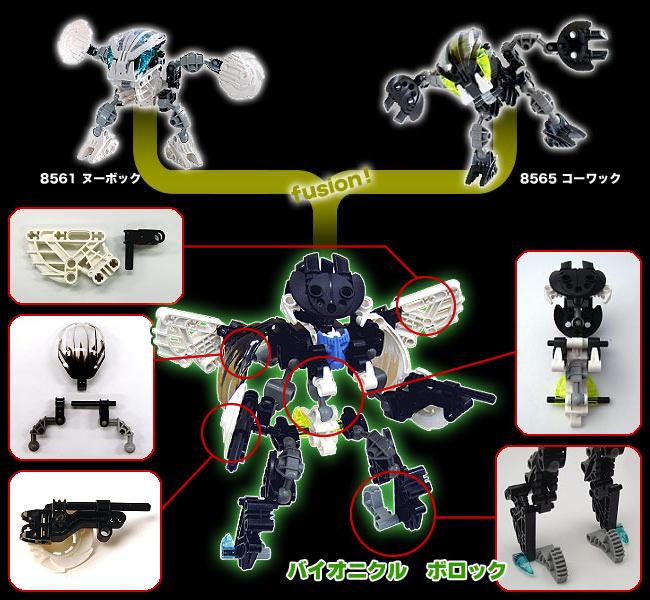

The final combiner for this time is the Bahrag Spider. According to the BS01 wiki, this creature has no canonical significance, but that doesn't keep me from including it in the Swarm. Perhaps the Bahrag Queens were actually triplets, not twins, and the Spider is the forgotten and deformed third sibling. Actually, that's my headcanon now. It's a fun build, for sure, and does some interesting things with the Bahrag pieces. Beneath the picture, I've included a video demonstrating its biting mechanism.


That's it for today. Next time we'll finish up 2002 with the menagerie of combiner fauna and Master Builder Set, all presided over by the two version of the Exo-Toa. See you then.