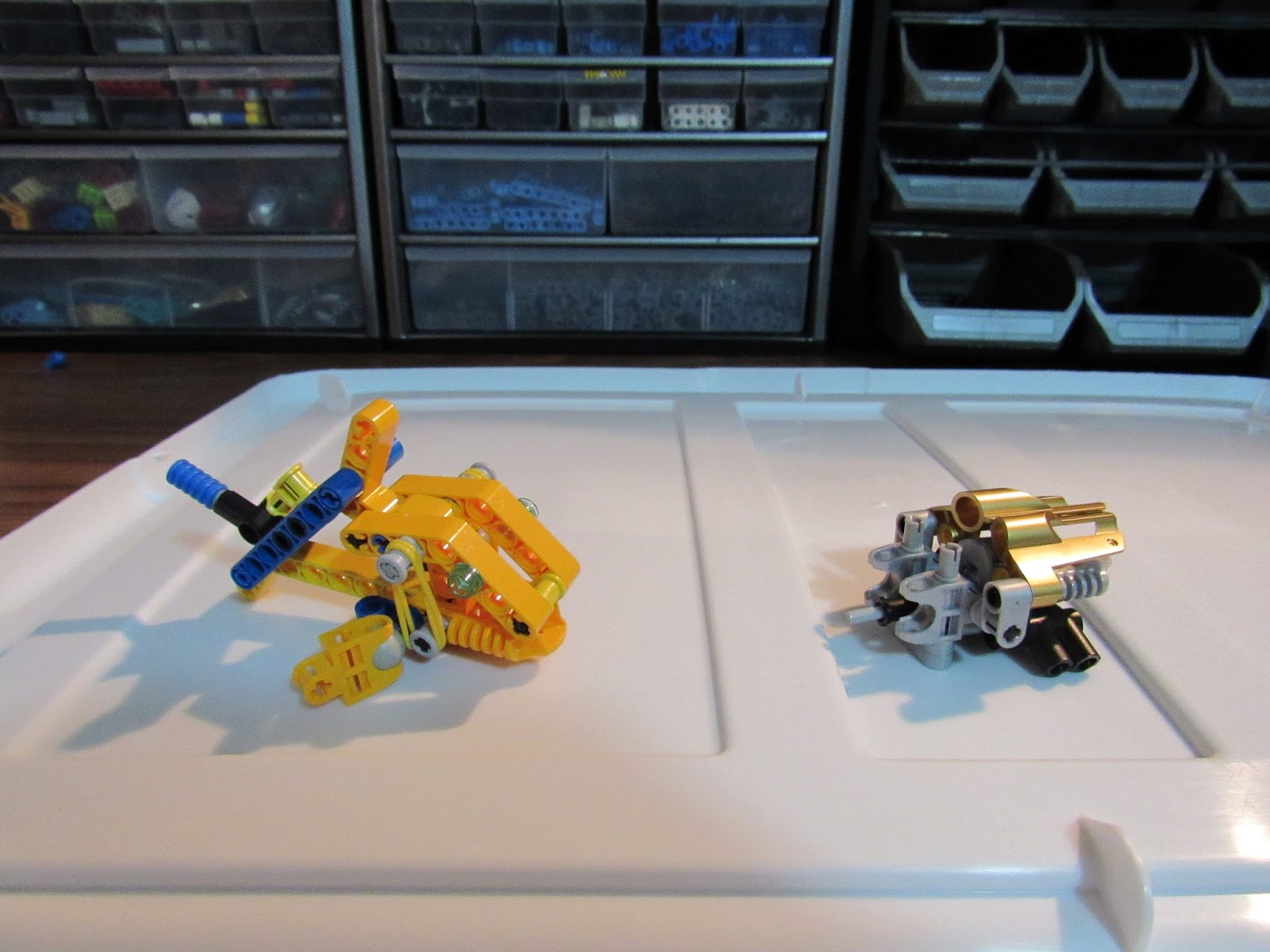
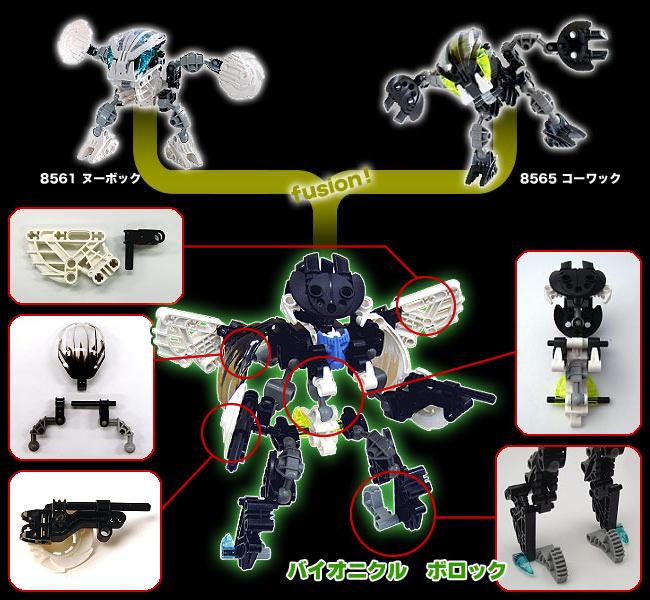
Before Mask of Light dropped and we were graced with an official Makuta set amongst the large sets of 2003, the Toa Nuva had to finish dealing with their Bohrok problem. Though the swarms were defeated, and then Bahrag re-imprisoned, a last ditch failsafe plan comes into play, and six very special Bohrok attempt to steal the Toa's powers and reawaken the queens. The Bohrok-Kal.
As you can see, they're basically Bohrok with new paint jobs and tools, though they really are pretty badass, and in-story (which I'll be reading through in comics over at the Giant Box of Comics pretty soon) they bring the Toa to their knees.
Though, so do all of the other villains, really. And the Toa always bounce back. You know they do.
It seems that it wasn't only the toys that were starting to clone in 2003, and perhaps that's why the Mask of Light film seemed, despite the title, so lackluster. And even the promise of the awakening of Mata Nui, which was only really mysteriously hinted at in the film, wasn't enough to save the movie.
The Bohrok-Kal are notable, at least in my personal opinion, for one thing: one of their combiners. To combat the Toa Kaita Nuva, the Bohrok-Kal were gifted with the ability to fuse into a gestalt entity known as Bohrok-Kal Kaita Ja. He's a pretty great model, and as with Wairhua Nuva from 2002, branches out somewhat from the typical build.
Whatever that might mean.
This is all to say that Kaita Ja is one of my favourite models. I've used the head build for him in a couple of MOCs, and I don't think he's given up all of his secrets yet.
Today's post is going to be a bit short. I don't really have much to say about the Kal that I haven't said about their less-powerful cousins. The notable bits of this year happen in the second wave and in conjunction with the release of the film. The Kal suffer for this, feeling like an afterthought of the previous year's storyline, and a prologue, but not that important a one, for the coming of the Toa of Light.
Who we'll meet soon. But first, the children of Makuta rise, and the Toa actually face something they haven't yet encountered - real evil. Beware the Rahkshi.
Wednesday, May 11, 2016
Wednesday, May 4, 2016
The Building Chronicle: A Critical Consideration of LEGO's "Bionicle" Series - Building Through part 3.1 - 2003
2003 was an exciting year for Bionicle. Following the
release of the first wave with the Bohrok-Kal, news broke of a film in the
works. I was absolutely stoked to see a Bionicle film, to see the Toa, even if
it was the Toa Nuva, walking around, talking, interacting with an environment
as rich and mysterious as Mata Nui.
It was…well, anti-climactic. But I think that a problem that
often happens with childrens’ features that are released directly to home media
is that they’re not courting the adult market that a film released in the movie
theatres needs to. Even if that market is just parents taking their kids to the
film, there has to be something, so the parents will deign to come back for the
next film. Pixar are masters of this. Bionicle:
The Mask of Light was not.
But that’s not that big a deal. Not all branches that a
franchise grows into can be amazing.
How were the toys?
I sometimes get the feeling in fandom that 2003 isn’t
well-liked. The proto-titan sets of Jaller and Gukko, and Hewkii and Pewku
usually meet lukewarm reception, as do the revamped Tohun….er…..Matoran (their
name is changed as Lego is faced with a lawsuit from the Maori people over
intellectual property issues – my thoughts on this are stewing still – I see
both sides, and I’m not sure what the solution is). The Rahkshi are cool, but
are clones, as are the earlier Bohrok-Kal. But there’s some interesting spots.
In lieu of a video of me putting something together, I’ll jump right in, and we’ll
look at the smallest sets of the wave, the Matoran.
To cap this sort of disappointing revamp of what were once
badass villagers, there was no combiner and only three of the villages were
represented – Ko-Wahi, Ga-Wahi, and Po-Wahi, or White, Blue, and Brown. The
larger sets featured red characters from Ta-Wahi, but never were any Onu- or
Le-Matoran produced. And as a result of the colour schemes of the existing
ones, MOCs are difficult to make.
But back to the combiners, or lack thereof.
A
few years back, I discovered something in the recesses of BioSector01 (and,
actually, right now, as I search for the link, I’ve just discovered something
else in there, another Kabaya combiner – off to hunt again!). This picture, of
what’s called the Matoran
Kohlii Combiner is all the information I have about this model. I don’t
know where the picture came from. But, as I gradually gathered the pieces
together, I decided to attempt to build it. It’s an interesting process in
the case where all one has is a relatively low-res picture. What I did was first figure out which Matoran it utilized. Then I
went through my collection and put together as much of each of them as I could,
which was a fair bit. And then, using only those pieces, I tried to put this
four-armed dude and his dog together. The result was pretty good (though I’m
still missing two light blue torso pieces for the feet.
I’ve messed about trying to make Matoran for the other
villages, but their body pieces are so specific to their region that it’s
virtually useless. I painted up some pieces to make an Onu-Matoran once, and I
may attempt with my newfound proclivity for painting to create some Le-Matoran.
We’ll see.
Before I finish for today, I can’t remember if I’ve
mentioned the BioMedia Project before, but it’s an online initiative to archive
all of the Bionicle digital media from the first and second generations of the
series. Bionicle was one of the first media properties to really explore
digital space, and it’s worth noting how it all happened. Here’s a video from
2003, one that was unlockable with codes one collected from the cannisters,
called “Rahkshi Rock.” We’ll talk Bohrok-Kal next time.
Labels:
2003,
Bionicle,
Bohrok-Kal,
collecting,
combiners,
criticism,
film,
LEGO,
links,
Mask of Light,
Matoran,
picture,
Rahkshi,
video
Monday, April 25, 2016
The Building Chronicle: A Critical Consideration of LEGO's "Bionicle" Series - Building Through part 2.4 - 2002
By way of wrapping up my look at 2002, I present the Master Builder/Combiner menagerie. One of my criticisms of the latest wave of Bionicle is its focus solely on characters on the island of Okoto, and not the island itself. In the early years of Generation 1, we were treated to numerous creatures, either made using other sets or as sets in and of themselves. The Master Builder Set, a Lego Store exclusive in 2002, widened the variety of creatures one could encounter on Mata Nui substantially, and they're a lot of fun to build. Rather than try to build a creature using the set pieces and then take it apart to build the next one, I used pieces from my collection to represent all of the possible builds from the set. Some of them turned out quite nicely.
Here we have the Ruki and the Hoto. I had very recently seen my son's drama department production of The Little Mermaid, and it was only when I'd finished building the Ruki that I realized I'd made a Bionicle version of Flounder!
Next is the Makika and the Kofo Jaga. I like the Kofo, and it looks nice displayed next to the previous year's Nui Jaga. It also offers one of the very few instances where it looks like there are particular Genus (Jaga) on the island, comprised of separate species (Kofo, Nui).
Here we have the Vako and the Takea. One of these days I'm going to make a larger version of the Takea (probably just using the same instructions, but with longer lift arms), as I feel like this should be like a Great White Shark in the waters surrounding Mata Nui.
The Goko-Kahu and the Kuna are next. The Kuna is cool, using the lift arms of the set in novel configurations to simulate an undulating snake. It's not the most successful of experiments, but it does the trick. The Goko-Kahu (also called the Kewa) is a strange, bird-like creature. You'll see that I used a Roborider head for this version, as I like the colour scheme, but wasn't willing to clean off the pattern.
The Husi and the Fusa are two of my favourites from this set. Most of the models in this set have actions, except for the very small creatures. The Husi offers amazing poseability, due in part to it's use of the Throwbot build to move it's head. The Fusa is like a boxing Kangaroo Rat, and is a really fun build.
The last three from the Master Builder set are the Hoi, the Fikou (which we've seen last year in black, and which we'll see as a promotional set next year in orange), and the creature that graces the cover of the MBS instructions, the Hikaki. The Hoi is an adorable little sea turtle, and I once made an entire tribe of them that lived under a shelf in my library. I may get the colony started again when I have some clear space. The Hikaki is a cool model, definitely something that one could see interacting with the more mainstream figures and creatures of the series.
Our final three creatures are Bohrok combiners the instructions for which were on the Lego website at the time. The Waikiru is constructed from parts of Pahrak, and is a cute little seal-type creature. The Ghekula, built from Lehvak and Gahlok seems to be part frog, part bull, which is actually a kind of badass mixture. The Keras, constructed from Lehvak and Tahnok is an excellent crab model. There seem to be a lot of different kinds of crabs on Mata Nui.
That does it for 2002. This was the last real glut of creatures on the island. Next year, the story arc becomes highly focussed on the Toa and the Matoran, and though 2004's wave teases an archive beneath Metru Nui filled with strange creatures, we only get model representation of a few. But first, Makuta makes his move, the Rahkshi storm the island, and a storyteller fulfills his destiny.
Contest!!
It's been nearly 2 months since I've updated this blog, due to a number of reasons that continue to feel like they're beyond my control!
But later today, I'm planning on finishing up 2002 in my Bionicle build-through, and start 2003. To celebrate, I'm going to hold a draw. The prize package is as follows:
1 Vahki Bordakh - used set, but complete, including instructions
1 McDonalds Toa Hahli Inika figure, sealed in bag
1 Bionicle comic, issue #19, featuring Bordakh on the cover - will ship flat, bagged and boarded
1 flat silver Kanohi Avohkii (The Mask of Light)
1 green Ehlek head
Entering is easy. One entry per person, just leave a name in the comments section. In one month, May 25, 2016, I'll randomly draw one name and that person will be the winner. I'll announce it here, and then we'll figure out the rest of the details then.
But later today, I'm planning on finishing up 2002 in my Bionicle build-through, and start 2003. To celebrate, I'm going to hold a draw. The prize package is as follows:
1 Vahki Bordakh - used set, but complete, including instructions
1 McDonalds Toa Hahli Inika figure, sealed in bag
1 Bionicle comic, issue #19, featuring Bordakh on the cover - will ship flat, bagged and boarded
1 flat silver Kanohi Avohkii (The Mask of Light)
1 green Ehlek head
Entering is easy. One entry per person, just leave a name in the comments section. In one month, May 25, 2016, I'll randomly draw one name and that person will be the winner. I'll announce it here, and then we'll figure out the rest of the details then.
Wednesday, February 3, 2016
The Building Chronicle: A Critical Consideration of LEGO's "Bionicle" Series - Building Through part 2.3 - 2002
Welcome to The Swarm! Above you see the majority of my Bohrok swarm, minus of course the 2003 Bohrok-Kal, and the Bahrag Spider, a combiner that wouldn't fit on the shelf, and that I'll show a little further down.
As I noted in my introduction to 2002, the cloning of the Bohrok in this wave led to a troubling trend in Bionicle. The two villain series of the next wave, the Bohrok-Kal and the Rahkshi, follow this trend, changing only colour and accessory, but keeping fundamental builds the same across the series. It's for this reason that I find myself gravitating, during this particular build-through, to the combiner models. They simply offer more interesting entertainment, and sometimes challenge, than the official, or mainstream, models, however we might want to refer to them. Having said this, I do like the Bohrok and the Bohrok Va. Unlike the Toa Nuva that they oppose, these models offer far more flexibility when it comes to posing, though not quite as much as the waves later in the decade. The Bohrok attack function is also pretty neat, and offers a nice combination of action figure and Technic parts. If only they'd been a bit more varied in their construction. The smaller Bohrok Va are also mostly cloned figures, though some of the leg and head assemblies vary enough to keep them interesting, despite their low piece count. Again, it's the combiners (or those that I have, at least) of these little figures that I find to be the more interesting parts of this wave.
But before I wax lyrical about the combiners, there's also the Bahrag Twins, Queens of the Swarm, to consider. Basically, they're Technic dragons. These figures, and the larger figures from the next wave, are ancestors of the Rahi from the first wave, built almost entirely of Technic parts, and not clad in any armour or accessories to disguise the fact. Whenever I build the Bahrag I have the same problem: once I've finished one, I'm less-inclined to build the next, since they are virtually the same model, part colour aside. They're also fairly lengthy builds, so once one is done, I usually take a break and build some of the other Swarm members before moving on to the next Queen.
These next two models are the combiners, the Bohrok Kaita, the instructions for which are in the backs of the Bohrok books. Though there are slight variations in the torso builds, these models are very similar to the Toa Kaita and Toa Kaita Nuva. This is not to say that they're uninteresting, and one of the most fascinating things about the various combiner models is the ability of the Lego designers to create a relative coherent model out of pieces that were never actually designed to create such things. The pieces in these models were explicitly designed to build the individual Bohrok models. Combining them into these giants is really pretty cool. Both retain the Bohrok head -thrusting action, and are relatively poseable, though the legs are a bit wobbly, due to the nature of the individual Bohrok leg pieces.
The next combiner is a Japanese model, the construction video for which I posted in the introduction to this section. Like it's larger compatriots, it's a bit wobbly, but the fashioning of accessories out of the Bohrok body parts, and the aesthetic quality of the model make it something interesting. The instructions, much like those for the Kabaya Rahkshi combiners from the next wave, are worth mentioning as well. Unlike the step by step instructions commonly found in Lego manuals, these combiner instructions assume a familiarity with how the pieces work, and instead of going piece by piece, the instructions go section by section. It raises the level of the challenge, especially when one is working from low resolution scans.
The final combiner for this time is the Bahrag Spider. According to the BS01 wiki, this creature has no canonical significance, but that doesn't keep me from including it in the Swarm. Perhaps the Bahrag Queens were actually triplets, not twins, and the Spider is the forgotten and deformed third sibling. Actually, that's my headcanon now. It's a fun build, for sure, and does some interesting things with the Bahrag pieces. Beneath the picture, I've included a video demonstrating its biting mechanism.
That's it for today. Next time we'll finish up 2002 with the menagerie of combiner fauna and Master Builder Set, all presided over by the two version of the Exo-Toa. See you then.
Wednesday, January 27, 2016
The Building Chronicle: A Critical Consideration of LEGO's "Bionicle" Series - Building Through part 2.2 - 2002
Okay, I lied slightly. Last time I said we'd have a look at the Swarm, but we're not. Not quite yet. First we'll look at the Toa Nuva, superpowered versions of our six focal heroes from 2001, and at the Tohunga/Matoran, who start to fight back against the threats to the island of Mata Nui.
(Note: the controversy over the term "Tohunga" stems from an appropriation by the Lego company of Maori terms for their own use. A Tohunga is an expert practitioner, often a priest, in Maori culture. Thus the Tohunga from 2001 and 2002 become the Matoran of 2003.)
As I mentioned last time, I'm not a huge fan of the protodermis-mutated masks of the Toa Nuva. Some of them are cool. I really like Gali Nuva's mask, though I wish it had been transparent blue, like her old one. I think my main problem with them is that where the original masks and original Toa were designed together, the Nuva bodies are only very basic redesigns of the originals, yet the masks are radical redesigns that, in my opinion, are far too large for the older bodies. Now, having said that, the addition of the early armouring goes some distance toward fixing this problem, but, as I've said, not enough I think.
The various Toa teams straddle an interesting line between originality and cloning throughout the first decade of Bionicle's existence. In some cases, the Inika series for example, there is so little differentiation (aside from colour) that the figures are amongst the least popular of the series. Their second form, however, the Toa Mahri involves perhaps the most diverse range of builds that the Toa ever see. In this, we see an important delineation between the ways we can think, and how collectors think, about these series. On the one hand, we can talk about the models from the perspective of what kinds of different flourishes, different armours and weapons, a model possesses, and on the other we can talk about them from the perspective of the complexity, or novelty, of the build. It is the sets that do both that are often the most popular and lauded.
In the 2001 series, it was the Rahi that provided this novelty of building, and for 2002 it is the proto-Titan models that do so. For today's post, these novel builds are represented by the Toa Nuva combiners, and the two variations of the Boxor. I've already waxed lyrical about the Wairhua Nuva combiner, who is sadly obscured behind a clock in the picture. Akamai Nuva, our other combiner, is a very basic redesign of the original Akamai, and, if I'm to be honest, is not really that interesting. The Boxor, both versions, on the other hand, offer both a novel build and a cool aesthetic design, which makes them one of my favourites of this wave. The creator of the Boxor (which, rather macabrely, is built from destroyed Bohrok) is the Tohunga Nuparu, who eventually becomes one of the aforementioned Toa Inika. He's interesting, in that of the Inika, he's one of only two who is not based on one of the 2001 McToran figures. The Boxor is one of the last gasps of truly Technic-style building for the Bionicle line. The main model features a punching motion that is activated by pushing down on the model and making it walk. The gear assembly for this model is really great. The secondary model (over to the far right in the picture) isn't quite as interesting, but certainly offers some variety in a wave that is, sadly, overly clone.
That's enough for today, I think. I'll move on to the Swarm next time, and then the Rahi zoo of the Master Builder Set.
(Note: the controversy over the term "Tohunga" stems from an appropriation by the Lego company of Maori terms for their own use. A Tohunga is an expert practitioner, often a priest, in Maori culture. Thus the Tohunga from 2001 and 2002 become the Matoran of 2003.)
As I mentioned last time, I'm not a huge fan of the protodermis-mutated masks of the Toa Nuva. Some of them are cool. I really like Gali Nuva's mask, though I wish it had been transparent blue, like her old one. I think my main problem with them is that where the original masks and original Toa were designed together, the Nuva bodies are only very basic redesigns of the originals, yet the masks are radical redesigns that, in my opinion, are far too large for the older bodies. Now, having said that, the addition of the early armouring goes some distance toward fixing this problem, but, as I've said, not enough I think.
The various Toa teams straddle an interesting line between originality and cloning throughout the first decade of Bionicle's existence. In some cases, the Inika series for example, there is so little differentiation (aside from colour) that the figures are amongst the least popular of the series. Their second form, however, the Toa Mahri involves perhaps the most diverse range of builds that the Toa ever see. In this, we see an important delineation between the ways we can think, and how collectors think, about these series. On the one hand, we can talk about the models from the perspective of what kinds of different flourishes, different armours and weapons, a model possesses, and on the other we can talk about them from the perspective of the complexity, or novelty, of the build. It is the sets that do both that are often the most popular and lauded.
In the 2001 series, it was the Rahi that provided this novelty of building, and for 2002 it is the proto-Titan models that do so. For today's post, these novel builds are represented by the Toa Nuva combiners, and the two variations of the Boxor. I've already waxed lyrical about the Wairhua Nuva combiner, who is sadly obscured behind a clock in the picture. Akamai Nuva, our other combiner, is a very basic redesign of the original Akamai, and, if I'm to be honest, is not really that interesting. The Boxor, both versions, on the other hand, offer both a novel build and a cool aesthetic design, which makes them one of my favourites of this wave. The creator of the Boxor (which, rather macabrely, is built from destroyed Bohrok) is the Tohunga Nuparu, who eventually becomes one of the aforementioned Toa Inika. He's interesting, in that of the Inika, he's one of only two who is not based on one of the 2001 McToran figures. The Boxor is one of the last gasps of truly Technic-style building for the Bionicle line. The main model features a punching motion that is activated by pushing down on the model and making it walk. The gear assembly for this model is really great. The secondary model (over to the far right in the picture) isn't quite as interesting, but certainly offers some variety in a wave that is, sadly, overly clone.
That's enough for today, I think. I'll move on to the Swarm next time, and then the Rahi zoo of the Master Builder Set.
Wednesday, January 13, 2016
Flea Market Finds
This past weekend, I did something that I very rarely, if ever, do. I bought a box (a whole box!) of comics.
At a local flea market I found myself flipping through a single long box sitting below a vendor's table. I'd been disappointed with this trip to the Hillhurst-Sunnyside Community Centre, as this was the only box of cheap comics (and actually the only cheap comics, period) that I could find. There was one other vendor selling key Silver Age issues at guide prices, but no other "dollar bins." This particular one had quite a few issues of the latter bits of Avengers v.1, issues up in the 300s, which is the section of that series that I'm currently in the process of tracking down. So I'd decided to pick up a few, maybe $10 worth, when the lady behind the table said she'd do a good deal on the whole box. I considered for a few long moments, and then asked what kind of deal. She said $50 for the whole thing. Again, a few long moments passed, and then I agreed. I dashed to the ATM, got another $40 out, and left with a box of comics.
I've spent the last 4 days going through, databasing, bagging, boarding, removing duplicates. In the end, doubles included, there were 228 comics, which very roughly breaks down to 22 cents per issue. I think I did alright there.
Up above, there, you can see the collection laid out after I got home. The stacks of comics are all issues from the same, or similar, series. Thus, the Avengers pile is all Avengers. The Archie Comics pile is all Archie Comics (the only bit I haven't finished cataloging quite yet). I bought the collection primarily on the strength of the number of Avengers comics in it, though, of all the runs in the box, that was the one that produced the most duplicates. It was, in fact, the stuff that I initially dismissed as "filler" that turned out to be the gold amongst the dross (yep, I'm looking squarely at that enhanced cover Silver Sable #1 from the 90s).
Up in the top left corner there is a pile of The Official Handbook of the Marvel Universe, both initial and deluxe editions. I love these encyclopedias, so it was a nice treat to get them. I'm also in the process of tracking down duplicate issues of each one so I can remove the covers and use them as posters. There were a few doubles in that pile, but mostly it was new stuff. The large pile of Archie comics is mostly mid to late 80s. Betty and Veronica's fashion sense was, in a word, atrocious in that era. I remember living through those fashions, both the first time and in the ill-advised 80s revival that seemed to take the world by storm a few years back.
Next to the Archies is the pile of comics I was most surprised by. It's an almost complete run of Marvel Two-In-One, Marvel's solo title for The Thing, from #80 to #100. I had little to no interest in this run, written predominantly by Tom DeFalco, who I immediately associate with the deplorable Clone Saga. But, as my impetus for the 40 Years of Comics Project had it, I shouldn't automatically assume that a comic is bad having not read it. I did read a few of these issues (once I'm done with Age of Ultron, I'm going to devote a few weeks to the stuff in this collection), and I have to say I was pleasantly surprised. In particular, issue #86, and the story "Time Runs Like Sand," now ranks as one of my favourite comics ever. I'll re-read it and blog it next week some time.
There was also some late-era Fantastic Four v.1 in the box, which, again, I had little interest in, until I realized that it encompasses the majority of Walt Simonson's run on the title that I have been meaning to read for quite a few years now. So I'll chalk that up as a win too.
Before I talk about the other piles, I'll note that there were, as you can see, a number of individual issues of various comics. The ones I've read (Guardians of the Galaxy, Silver Sable) were pretty unremarkable, which is probably why whoever bought these in the first place didn't get any more.
I've already noted the Avengers comics as being the most important, at least from a collecting viewpoint, in the lot. Most of the pile of Superboy were duplicates, and in truly terrible shape. That version of the character was never one I had that much interest in, though the "Zero Hour" tie-in issue does feature the old, pre-Crisis Superboy, so that should be interesting. One thing I will note about the Avengers comics is that they included full runs of both Walt Simonson and John Byrne's tenures as writers on the title, both quite short, but probably pretty good.
The last little bit is that pile of Marvel Age comics, a good 30 of them in sequential order. This might seem a low point to end the assessment of the collection on, until one realizes that, by and large, these are comics that have never been reprinted. That is, of course, because the series functioned as a news magazine, and only included the occasional sequential strip (Fred Hembeck's center pages notwithstanding). What they do contain, however, is a chronological recounting of the events of each year of Marvel Comics narratives in the "Marvel Age" feature at the end of each issue. The earliest one I have starts in 1973, more than a decade after the "Age" begins. The articles are fantastic for the fact that rather than recounting publication history, they actually tell the fictional histories of the characters. I envision this as a scanning-and-sharing/cataloging project for the future. There's also occasional exclusive comics (like the Kirby/Stern piece that graces Marvel Age Annual #2, or the Shadowline summary from Annual #4) and the aforementioned Hembeck work, which I'm assuming has been reprinted somewhere, but maybe hasn't. Add to this the occasional article about the workings of the company, faux Daily Bugles, and such, and it's actually a pretty great find. Not one that I ever would have gone out of my way for, but pretty great nonetheless.
And that's it. As I said, I don't buy collections like this very often, due to both space and financial constraints, but I felt like treating myself on the weekend, and it turned out to be more of a treat than I'd expected. Look for some examples of what was in the collection over the next couple of weeks of the 40 Years project.
At a local flea market I found myself flipping through a single long box sitting below a vendor's table. I'd been disappointed with this trip to the Hillhurst-Sunnyside Community Centre, as this was the only box of cheap comics (and actually the only cheap comics, period) that I could find. There was one other vendor selling key Silver Age issues at guide prices, but no other "dollar bins." This particular one had quite a few issues of the latter bits of Avengers v.1, issues up in the 300s, which is the section of that series that I'm currently in the process of tracking down. So I'd decided to pick up a few, maybe $10 worth, when the lady behind the table said she'd do a good deal on the whole box. I considered for a few long moments, and then asked what kind of deal. She said $50 for the whole thing. Again, a few long moments passed, and then I agreed. I dashed to the ATM, got another $40 out, and left with a box of comics.
I've spent the last 4 days going through, databasing, bagging, boarding, removing duplicates. In the end, doubles included, there were 228 comics, which very roughly breaks down to 22 cents per issue. I think I did alright there.
Up above, there, you can see the collection laid out after I got home. The stacks of comics are all issues from the same, or similar, series. Thus, the Avengers pile is all Avengers. The Archie Comics pile is all Archie Comics (the only bit I haven't finished cataloging quite yet). I bought the collection primarily on the strength of the number of Avengers comics in it, though, of all the runs in the box, that was the one that produced the most duplicates. It was, in fact, the stuff that I initially dismissed as "filler" that turned out to be the gold amongst the dross (yep, I'm looking squarely at that enhanced cover Silver Sable #1 from the 90s).
Up in the top left corner there is a pile of The Official Handbook of the Marvel Universe, both initial and deluxe editions. I love these encyclopedias, so it was a nice treat to get them. I'm also in the process of tracking down duplicate issues of each one so I can remove the covers and use them as posters. There were a few doubles in that pile, but mostly it was new stuff. The large pile of Archie comics is mostly mid to late 80s. Betty and Veronica's fashion sense was, in a word, atrocious in that era. I remember living through those fashions, both the first time and in the ill-advised 80s revival that seemed to take the world by storm a few years back.
Next to the Archies is the pile of comics I was most surprised by. It's an almost complete run of Marvel Two-In-One, Marvel's solo title for The Thing, from #80 to #100. I had little to no interest in this run, written predominantly by Tom DeFalco, who I immediately associate with the deplorable Clone Saga. But, as my impetus for the 40 Years of Comics Project had it, I shouldn't automatically assume that a comic is bad having not read it. I did read a few of these issues (once I'm done with Age of Ultron, I'm going to devote a few weeks to the stuff in this collection), and I have to say I was pleasantly surprised. In particular, issue #86, and the story "Time Runs Like Sand," now ranks as one of my favourite comics ever. I'll re-read it and blog it next week some time.
There was also some late-era Fantastic Four v.1 in the box, which, again, I had little interest in, until I realized that it encompasses the majority of Walt Simonson's run on the title that I have been meaning to read for quite a few years now. So I'll chalk that up as a win too.
Before I talk about the other piles, I'll note that there were, as you can see, a number of individual issues of various comics. The ones I've read (Guardians of the Galaxy, Silver Sable) were pretty unremarkable, which is probably why whoever bought these in the first place didn't get any more.
I've already noted the Avengers comics as being the most important, at least from a collecting viewpoint, in the lot. Most of the pile of Superboy were duplicates, and in truly terrible shape. That version of the character was never one I had that much interest in, though the "Zero Hour" tie-in issue does feature the old, pre-Crisis Superboy, so that should be interesting. One thing I will note about the Avengers comics is that they included full runs of both Walt Simonson and John Byrne's tenures as writers on the title, both quite short, but probably pretty good.
The last little bit is that pile of Marvel Age comics, a good 30 of them in sequential order. This might seem a low point to end the assessment of the collection on, until one realizes that, by and large, these are comics that have never been reprinted. That is, of course, because the series functioned as a news magazine, and only included the occasional sequential strip (Fred Hembeck's center pages notwithstanding). What they do contain, however, is a chronological recounting of the events of each year of Marvel Comics narratives in the "Marvel Age" feature at the end of each issue. The earliest one I have starts in 1973, more than a decade after the "Age" begins. The articles are fantastic for the fact that rather than recounting publication history, they actually tell the fictional histories of the characters. I envision this as a scanning-and-sharing/cataloging project for the future. There's also occasional exclusive comics (like the Kirby/Stern piece that graces Marvel Age Annual #2, or the Shadowline summary from Annual #4) and the aforementioned Hembeck work, which I'm assuming has been reprinted somewhere, but maybe hasn't. Add to this the occasional article about the workings of the company, faux Daily Bugles, and such, and it's actually a pretty great find. Not one that I ever would have gone out of my way for, but pretty great nonetheless.
And that's it. As I said, I don't buy collections like this very often, due to both space and financial constraints, but I felt like treating myself on the weekend, and it turned out to be more of a treat than I'd expected. Look for some examples of what was in the collection over the next couple of weeks of the 40 Years project.
Subscribe to:
Posts (Atom)